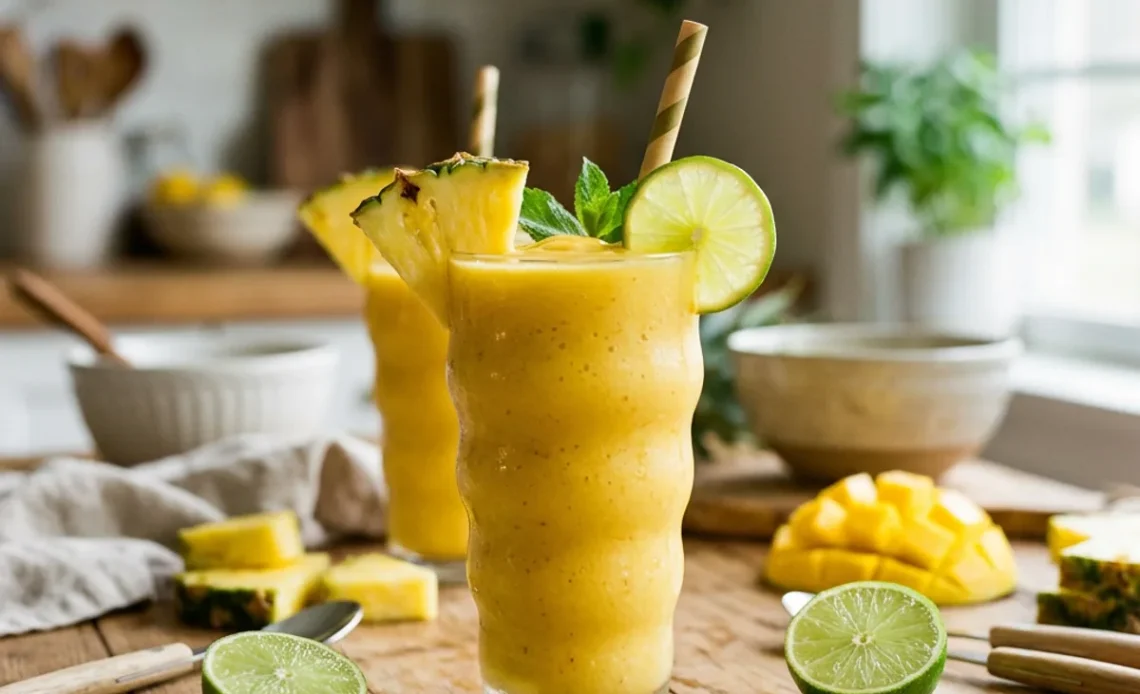
A tropical smoothie is pineapple, mango and banana blended with a cold liquid until thick and golden, and this one takes five minutes and five simple ingredients. The one detail that matters is frozen fruit: it makes the tropical smoothie thick and cold without watering it down.
The short answer: a tropical smoothie is frozen pineapple and mango, a banana and a cold liquid, blended until thick. Use about 2 cups of fruit to 1 cup of liquid for two glasses. Smoothies fill you up, but we found no study showing they help with bloating.
Why this tropical smoothie recipe works
Most watery smoothies come from one thing: too much liquid and not enough frozen fruit. We fix both. The banana adds body and sweetness, the pineapple brings acidity, the mango brings a round, floral sweetness, and a spoonful of lime juice keeps it from tasting flat.
You can adjust the sweetness to your taste: a very ripe banana and ripe mango need nothing else, and if your fruit is tart, a few extra mango cubes work better than sugar.
Tropical smoothie recipe variations
| Variation | What changes | The result |
|---|---|---|
| Green tropical | Add a large handful of baby spinach | Same flavor, a green color and a little more fiber |
| Coconut cream | Swap almond milk for a coconut milk drink | Rounder, more dessert-like |
| Ginger lime | Add a thin slice of fresh ginger and extra lime juice | Sharper, more refreshing |
| Smoothie bowl | Use half the liquid and spoon it into a bowl | Thick enough for toppings |
| Slushy | Add 1 cup of ice and blend a little longer | Cold, frosty and lighter |
For a mango-forward glass, our mango smoothie recipe is the closer match.
Other tropical fruit fit the same base. Papaya, kiwi, passion fruit pulp or a bag of frozen tropical mix can replace part of the mango or pineapple. Keep the total near 2 cups of fruit so the balance of fruit to liquid stays the same.
For a plain base that works with any bag of frozen berries or mango, see our fruit smoothie with frozen fruit.
If you would rather sip the fruit on its own, see how to make passion fruit juice at home.
How to make a tropical smoothie recipe at home
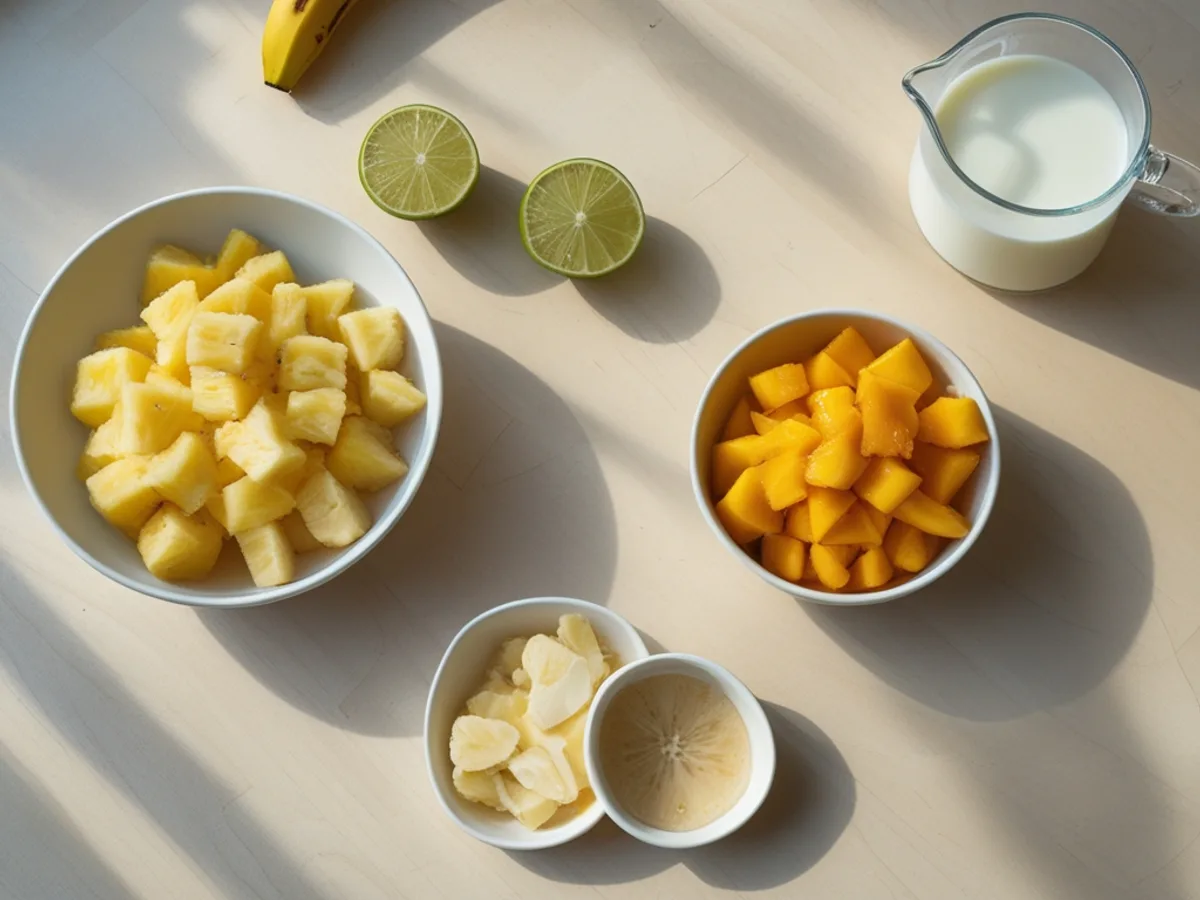
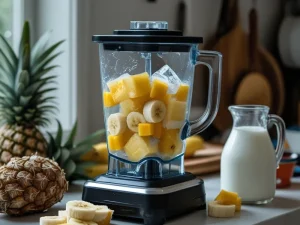
For two glasses you need 165 grams of frozen pineapple (about 1 cup), 165 grams of frozen mango, 1 ripe banana, 1 cup of cold unsweetened almond milk and 1 tablespoon of lime juice. You will find the step-by-step version on the recipe card at the end.
Three small details make this tropical smoothie recipe work:
- Liquid first. Pouring the milk in first lets the blades pull the fruit down.
- Frozen, not iced. Frozen fruit thickens the tropical smoothie. Ice only waters it.
- Scrape once. Stop at 20 seconds, scrape the sides, then blend again for a uniform texture.
Mathieu M kept strictly to these quantities and got the thick texture hoped for, a delicious glass that was easy and quick to put together, and one to make again.
Which liquid to use
The liquid sets the body and the sweetness, so choose it with care. Unsweetened almond milk keeps the recipe dairy-free and adds no sugar, which is why we use it. A coconut milk drink makes it rounder, and coconut water makes it lighter and thinner. Pineapple or orange juice adds flavor, but it also adds sugar on top of the fruit: if you use juice, replace only part of the milk with it.
For a crowd, double or triple the quantities and blend in batches if your blender is small.
Tips and common mistakes
- Too thin? Use less liquid, not more ice. Start with 1 cup for two glasses and add a splash at a time.
- Not sweet enough? Use a riper banana or a few extra mango cubes before you reach for sugar.
- Chunky? Stop at 20 seconds, scrape the sides and blend again.
- Too tart? Pineapple varies a lot. A little extra banana rounds it out.
- Watery after sitting? Fruit smoothies separate, so stir them or blend again for 5 seconds.
Bahama mama recipe tropical smoothie: the pink, creamy twist
If you like the sweet, creamy pink version, build it from your own pantry instead of a menu. Swap the mango for 1 cup of frozen strawberries, keep the pineapple and banana, and use a coconut milk drink in place of the almond milk. You get a pale pink, coconut-sweet glass with the same easy method. It is inspired by the flavor combination, not a copy of any café recipe. If you like creamy fruit drinks, you may also enjoy our strawberry lassi recipe and our mango lassi recipe.
Make it lighter without losing the flavor
A tropical smoothie is already close to fruit in a glass, and three small choices keep it that way:
- No added sugar. The recipe gets its sweetness from ripe fruit, and the unsweetened almond milk adds none. A riper banana is the first thing to try if you want it sweeter.
- Whole fruit, not juice. Blending keeps the whole fruit, so the fiber stays in the glass, which helps the tropical smoothie feel more filling than a glass of juice.
- A handful of greens. A large handful of baby spinach adds fiber and almost no taste, and it helps you eat more vegetables without noticing.
- More protein, if you want it. Plain Greek yogurt in place of part of the almond milk adds protein and makes the tropical smoothie thicker, and a spoonful of chia or ground flax seeds adds fiber. Both help the tropical smoothie hold you longer; the yogurt means it is no longer dairy-free.
What the studies say about smoothies
Smoothies are a popular topic, and the research is modest. A 2018 randomized trial in Nutrients (PMID 29601488) compared water, blackcurrant squash, milk, a fruit smoothie and the fresh fruit equivalent of the smoothie. Adults rated how full each preload made them feel and how much they then ate at a test meal. The authors report that fullness increased with how food-like the drink seemed, and that later energy intake did not differ between the energy-containing drinks and the fresh fruit.
So a smoothie is not a miracle, and it is not a problem either. It is fruit in a glass. Notice that the study did not look at bloating or at a tropical blend, and that it was small. You decide how it fits in your day.
Safety: who should check first
- Natural sugar. Pineapple, mango and banana carry natural sugars. If you count carbohydrates or manage blood sugar, ask your doctor or dietitian how a fruit smoothie fits.
- Allergies. Mango, pineapple and tree nut milks cause allergies in some people. Swap in oat or coconut milk if you avoid almonds.
- Children. Keep the portion small, and check for choking risk with large frozen chunks if you serve it to very young children.
Nutrition and storage
One glass (half the recipe) works out to about 168 calories, 38 g of carbohydrate, 3 g of protein and 73 mg of sodium. The numbers come from USDA FoodData Central values for pineapple, mango, banana, almond milk and lime juice, and stay an estimate. Most of the carbohydrate is the natural sugar of the fruit.
Make it fresh. If you must store it, keep it in a closed jar in the refrigerator for up to 24 hours and stir well before drinking. Leftovers also freeze well in ice pop molds for a cold snack.
For your next blend, browse our smoothies and fruit drinks.
Sources
- A Comparison of the Satiety Effects of a Fruit Smoothie, Its Fresh Fruit Equivalent and Other Drinks, Nutrients, PubMed
- Pineapple, raw, USDA FoodData Central
- Mangos, raw, USDA FoodData Central
- Bananas, raw, USDA FoodData Central
Tropical Smoothie Recipe: Thick, Golden, Ready in 5 Minutes
Ingredients
- 165 g pineapple about 1 cup of chunks, frozen
- 165 g mango about 1 cup of cubes, frozen
- 1 medium banana ripe, in chunks
- 1 cup unsweetened almond milk 240 ml, cold
- 1 tbsp lime juice about half a lime
- 4 ice cubes optional, for a thicker glass
Instructions
- Pour the almond milk into the blender first, then add the lime juice, banana, mango and pineapple. Liquid first keeps the blades moving and helps you avoid a stuck blend.
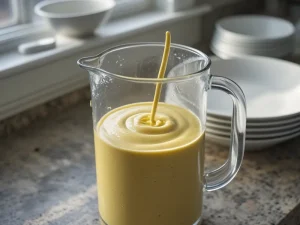
- Blend on high for 45 to 60 seconds, until no chunks remain. Stop and scrape once if the fruit sticks, then blend again. Add a splash of milk only if it will not move.
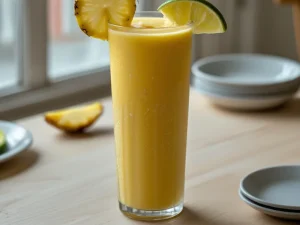
- Pour into two tall glasses, add a pineapple wedge or a lime wheel on the rim, and drink at once. A frozen-fruit smoothie is at its best in the first 10 minutes.
Notes
Frequently Asked Questions
What do tropical smoothies put in their smoothies?
Most tropical smoothies are built from fruit such as pineapple, mango and banana, a liquid such as milk, juice or coconut water, and ice or frozen fruit. This recipe uses pineapple, mango, banana, almond milk and lime juice.
Do smoothies help with bloating?
We found no study showing that a tropical smoothie helps with bloating. The research we found looks at fullness after a smoothie, not at bloating. If bloating is a frequent problem for you, talk to a doctor.
What is the 1-2-3 smoothie rule?
We found no official version of this rule, and the versions shared online differ. The ratio we use here is easy to remember: about 2 cups of fruit, 1 banana and 1 cup of liquid for two glasses.
What not to mix in a smoothie?
We know of no official list of foods that cannot go together in a smoothie. Practical limits are enough: too many strong flavors taste muddy, too much ice waters it down, and more than about four fruits is hard to balance.
Can I make a tropical smoothie without a banana?
Yes. Use an extra half cup of mango or a few spoonfuls of cooked, cooled sweet potato for body, and expect a slightly less creamy result.
How do I make a tropical smoothie thicker?
Freeze the pineapple and mango, add the liquid first and use less of it. Start with 1 cup of milk for two glasses and add a splash at a time.
Can I make a tropical smoothie ahead?
It tastes best fresh. You can freeze it in a jar for up to a day, then let it sit for 20 minutes and stir it. The texture is a little less light than a fresh blend.