
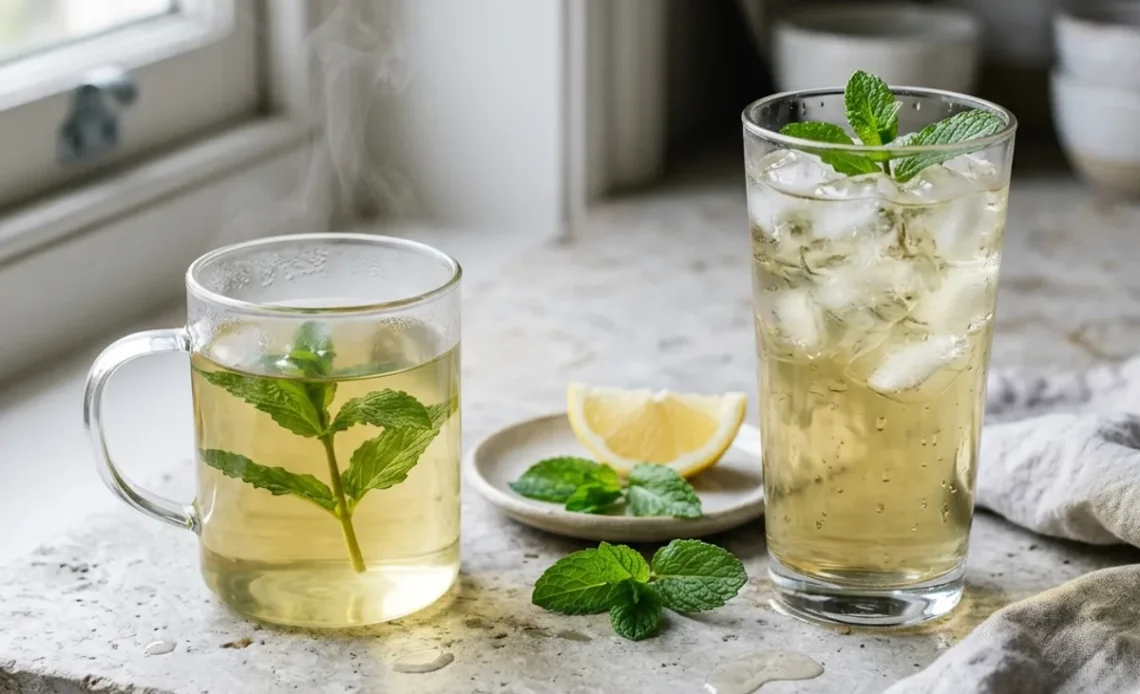
Start with a bunch of fresh peppermint and the rest is easy.
The short version: drinking peppermint tea at its best takes a loose handful of bruised leaves per mug, water just off the boil, a lid and 5 minutes. Strain, savor it hot or pour it over ice. Unsweetened, a mug has no caffeine and about 2 calories (USDA). Its health effects are far less proven than often claimed.
Bags and dried leaves work too, and the exact amounts for two mugs are in the recipe card.
I like peppermint tea plain, with nothing in it but the leaves. Its cooling, almost peppery bite is the whole point, and a good cup needs no sugar to taste finished. That makes it one of the easiest healthy swaps there is: a warm, flavorful drink you can have at any hour, with the evidence on what it does laid out further down, plainly.
| Way to brew | What you need per mug | Time | Good to know |
|---|---|---|---|
| Fresh leaves, hot | 1/2 cup loosely packed leaves, 1 cup water just off the boil | 5 to 10 minutes, covered | The brightest flavor; about 2 calories unsweetened (USDA) |
| Tea bag, hot | 1 bag, 1 cup water | 5 minutes, covered | The easiest; read the box to make sure it is pure peppermint |
| Dried loose leaves | 1 to 2 teaspoons, 1 cup water | 5 minutes, covered | Stronger and more mellow than fresh; keep the jar sealed |
| Iced, hot-brewed | The fresh-leaf cup, cooled and poured over ice | 5 to 10 minutes plus cooling | Brew it on the strong side, the ice dilutes it |
| Cold brew | 1/2 cup leaves or 1 bag in 1 cup cold water | Several hours in the fridge | Softer and sweeter, no kettle needed |
How to make tea from fresh peppermint leaves
Fresh leaves give the liveliest cup, and they are easy to come by: peppermint grows happily in a pot on a sunny windowsill, and most grocery stores sell it next to the basil.
Pick the right mint. Look for bright, firm leaves with no dark spots. Peppermint has slightly pointed, deep green leaves, often with a purplish tint on the stems. Smell a leaf: it should hit you with that cool, sharp scent right away.
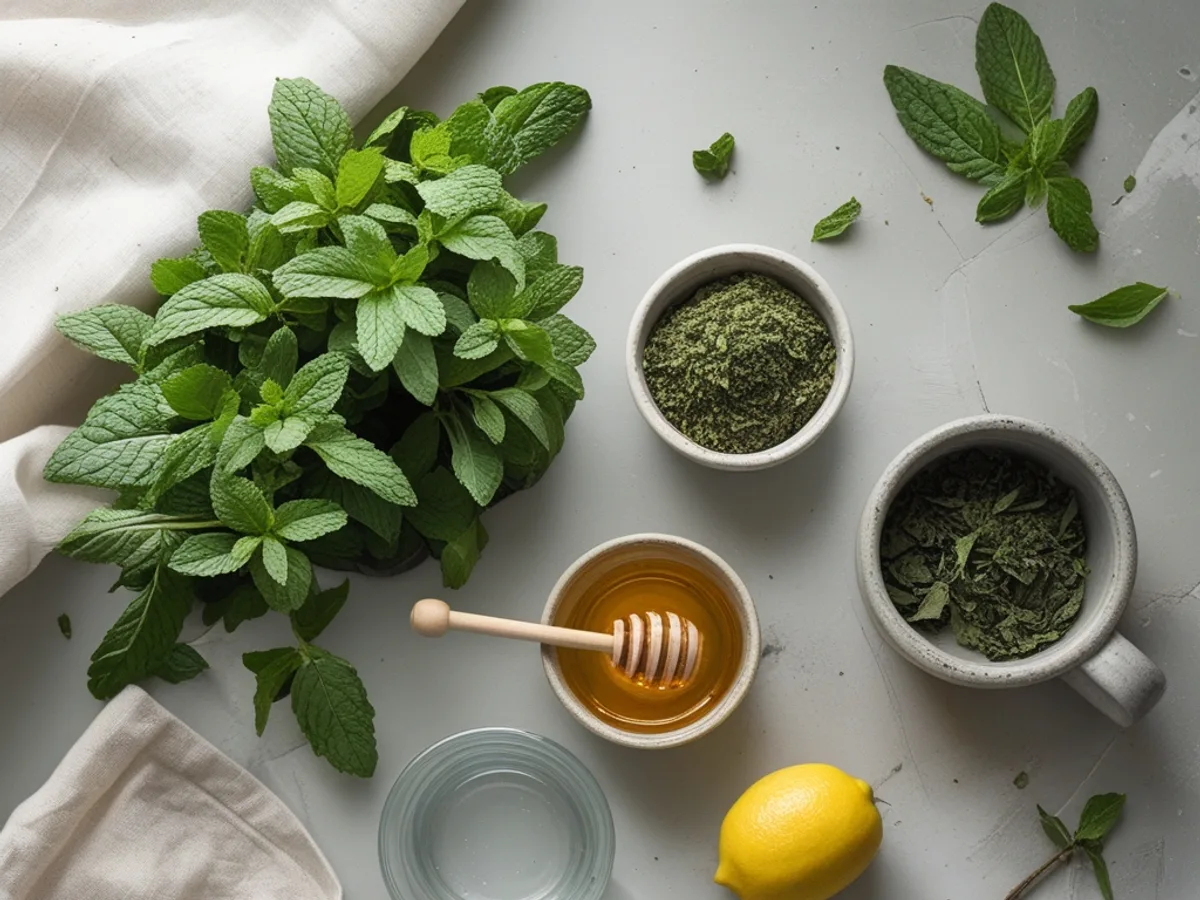
Use more leaves than you think. A loose half cup of leaves per mug, about one good handful, gives a full-flavored tea. A few sprigs in a big teapot make a cup that tastes of hot water with a hint of green.
Bruise, do not shred. Rolling or clapping the leaves between your palms breaks their surface and lets the aromatic oils escape into the water. Chopping them fine leaves little bits floating in the cup and can turn the flavor grassy.
Water just off the boil. Boil the water, then let it rest for about 30 seconds before pouring. It is hot enough to pull out all the flavor, and the leaves keep their color better than under a fierce boil.
Put a lid on it. The cooling scent of peppermint is the part that floats away with the steam. A lid on the teapot, or a saucer on a mug, keeps it in your cup.
If you only have a few sprigs, make one mug instead of two rather than stretching the leaves.
How long to steep peppermint tea
Short steeps of 2 or 3 minutes give a pale, gentle cup. I find that peppermint needs a little longer to show its character: 5 minutes covered is my starting point, and up to 10 minutes gives a deep, bracing tea that holds up well over ice. Taste as you go and stop when it tastes right to you. Fresh leaves, bags and dried leaves all sit comfortably in that 5 to 10 minute window.
Tea bags or dried leaves
On a busy morning, a bag is perfectly good peppermint tea. Use 1 bag per mug of water just off the boil, cover the mug with a saucer and leave it 5 minutes. Check the ingredient list on the box: some “mint” teas are blends with green or black tea, which means caffeine.
Dried loose leaves taste rounder and a little less sharp than fresh ones. Use 1 to 2 teaspoons per mug in an infuser or a small teapot, same lid, same 5 minutes. Keep the jar tightly closed, away from heat and light, and trust your nose: leaves that no longer smell of much will not make much of a cup.
Iced peppermint tea, two ways
Hot-brewed, then iced. Make the recipe as written, steeping for the full 10 minutes so the flavor survives the ice. Let it cool for a few minutes, then pour it into tall glasses packed with ice. Finish with a fresh sprig and a thin slice of lemon. For a pitcher, multiply the recipe and chill it in the fridge before serving.
Cold brew. Put the bruised leaves, or tea bags, in a jar of cold water, close it and leave it in the fridge for several hours or overnight. Strain it in the morning. Cold-brewed peppermint tea is softer and naturally rounder, a lovely summer drink straight from the fridge with no sweetener at all.
How to make peppermint tea taste better
When a cup tastes flat or harsh, one of these usually fixes it:
- Weak and watery. Too few leaves, or no lid. Double the leaves and cover the pot.
- Grassy or bitter. Leaves chopped too fine or stems left in. Use whole leaves, lightly bruised.
- Dull. Old dried leaves or a stale bag. A fresh jar or a handful of fresh leaves changes everything.
- Too sharp for you. Mix in some spearmint, or add a squeeze of lemon and a teaspoon of honey to round it out.
Easy flavor pairings
Peppermint gets along with a lot of flavors, so you can keep it unsweetened and still give it a new direction:
- Lemon: a thin slice or a squeeze of juice brightens it, hot or iced.
- Fresh ginger: two thin slices steeped with the leaves add warmth.
- Lemon balm: a soft, lemony herb from the same family; half and half with peppermint makes a gentle cup, and our lemon balm tea recipe shows how to brew it on its own.
- Chamomile: for an evening blend, add a spoonful of dried flowers, following the ratios of our chamomile tea recipe.
- Warm spice: one or two whole cloves turn it into a winter cup; if you like that flavor, the clove tea recipe is its spicier cousin.
- Berries: a few crushed raspberries or strawberries in the iced version give it color and a little natural sweetness.
You will find more hot and iced blends in our tea drinks collection.
Peppermint, spearmint or just mint?
“Mint” covers a whole family of plants. Peppermint, Mentha × piperita, is a natural cross between water mint and spearmint, according to the NIH’s National Center for Complementary and Integrative Health (NCCIH). Its leaves carry the cooling flavor most people think of as “minty”.
Spearmint is softer and sweeter, the mint of many garden beds. Both make a fine tea and you can mix them freely. This recipe works the same way with any fresh mint; only the strength of the bite changes.
Health benefits of drinking peppermint tea: what the evidence says
If you are drinking peppermint tea for your health, here is the plain picture: the tea itself has almost no clinical research. Most of the results quoted online come from studies of peppermint oil in capsules, a concentrated product that is not the same thing as a cup of tea.
What can be said with figures:
- No caffeine and about 2 calories. A cup of brewed herbal tea has 0 mg of caffeine and about 2 calories, according to USDA FoodData Central. Unsweetened, peppermint tea is about as light as a flavored drink gets, which helps with replacing sweet drinks, and it can be part of your water intake on a cold day.
- Peppermint tea, the drink. A 2006 review of peppermint research found that human studies of peppermint leaf are limited and that clinical trials of peppermint tea were absent; it also noted that adverse reactions to the tea had not been reported (PubMed 16767798, 2006). The NCCIH reaches the same conclusion today: there is not enough evidence to say whether peppermint leaf is useful for any health condition.
- Peppermint oil and irritable bowel syndrome. A 2022 systematic review and meta-analysis on the efficacy of peppermint oil in irritable bowel syndrome (IBS), pooling 10 trials with 1,030 patients, found the capsules better than placebo for overall IBS symptoms and abdominal pain, but side effects were more frequent and the authors rated the evidence on peppermint oil as very low quality (PubMed 35942669, 2022). One of the larger recent trials found no statistically significant reduction in abdominal pain with either of two peppermint oil capsules after 8 weeks (PubMed 31470006, 2020).
- Peppermint tea and medicines. In a small study, 9 healthy volunteers drank peppermint tea twice a day for six days; one drug-processing enzyme slowed slightly, and the authors suggest daily peppermint tea may change how some drugs are handled by the body (PubMed 28011360, 2017). Nine people is far too few to draw rules from, but it is a good reason to mention your tea habit to your doctor.
So enjoy it for what it is: a refreshing, caffeine-free drink that supports a low-sugar habit. If you are looking for relief from a digestive condition, that is a conversation for your doctor, not a reason to drink more tea.
Drinking peppermint tea while pregnant or breastfeeding
Peppermint in the amounts commonly found in food is likely safe during pregnancy or while breastfeeding, according to the NCCIH. Little is known about whether peppermint in medicinal amounts is safe at those times. A mug of tea brewed as in this recipe is a food amount; concentrated extracts, oils and several strong cups every day are a different matter. If you are pregnant or breastfeeding and want to make peppermint tea a daily habit, ask your health care provider first.
Who should avoid it or ask first
Peppermint tea made from the leaves appears to be safe, says the NCCIH, though the long-term safety of large amounts of peppermint leaf is unknown. A few situations call for care:
- Heartburn and reflux. Heartburn is one of the possible side effects of oral peppermint oil listed by the NCCIH, and a review of peppermint research notes that caution has been urged for peppermint oil therapy in people with reflux, hiatal hernia or kidney stones (PubMed 16767798). The NIH’s digestive disease institute (NIDDK) adds that some people with reflux find certain drinks trigger their symptoms and suggests talking with a doctor about them. If your cup is followed by heartburn, skip it.
- If you take any medicine. The NCCIH advises talking with your health care provider before using any herbal product, because some herbs and medicines interact.
- Allergy. Rarely, peppermint oil can cause allergic reactions, according to the NCCIH. If your mouth or throat tingles or swells, stop.
Talk with your doctor before relying on any tea for a health problem.
When to drink peppermint tea
Whenever it suits you. Because it has no caffeine, drinking peppermint tea before bed or after dinner is an easy habit, at an hour when coffee or black tea would be too much.
Drinking peppermint tea in the morning works just as well: an iced glass makes a refreshing start. The studies we read did not look at timing, sleep or weight loss, so pick the moment you enjoy it most.
Storing fresh leaves and brewed tea
Wrap fresh peppermint loosely in a damp paper towel and keep it in a bag in the fridge, or stand the stems in a glass of water like a bouquet. Use it within a few days, while the leaves are still firm.
Brewed tea tastes best the day you make it. Keep leftovers covered in the fridge and drink them cold within a day; strain the leaves out first so the tea does not turn bitter.
Where the numbers come from
- Nutrition and caffeine: USDA FoodData Central, brewed herbal tea and honey. The card values are estimates for one of 2 mugs with 1 teaspoon of honey each; USDA has no separate entry for brewed peppermint tea, so the general herbal tea entry is used.
- Safety: NCCIH (NIH), Peppermint Oil, and NIDDK (NIH), Eating, Diet, & Nutrition for GER & GERD.
- Studies: the PubMed records linked above, found through a search of reviews and trials on peppermint and peppermint tea.
Bruise the leaves, cover the pot, and give it five minutes: drinking peppermint tea is that simple, and that good, hot in winter or over ice all summer.

Drinking Peppermint Tea? How to Brew It Fresh, From a Bag or Iced
Ingredients
- 1 cup fresh peppermint leaves loosely packed, stems removed, about 2 good handfuls; or 2 peppermint tea bags, or 2 to 4 tsp dried leaves
- 2 cup water 480 ml
- 2 tsp honey optional, 1 tsp per mug
Instructions
- Rinse the peppermint and pat it dry. Pull the leaves off the stems and roll or clap them lightly between your palms, just enough to bruise them, then drop them into a teapot or a heatproof jug. Bring the water to a boil.
- Let the water stand off the heat for about 30 seconds, pour it over the leaves and put the lid on at once. Steep 5 minutes, taste, and give it up to 10 minutes if you like it stronger.
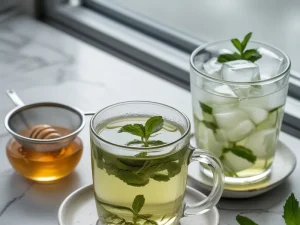
- Strain into two mugs, pressing the leaves gently with a spoon. Stir in a teaspoon of honey per mug if you want it and finish with a fresh sprig. For iced tea, let it cool for a few minutes and pour it into two tall glasses full of ice.
Notes
Nutrition
Frequently Asked Questions
What are the benefits of drinking mint tea?
Unsweetened, it is a caffeine-free, nearly calorie-free drink you can enjoy hot or iced, which helps with swapping out sweet drinks. The specific health effects people read about come mostly from trials of peppermint oil capsules; the NIH says there is not enough evidence to say whether peppermint leaf helps any condition.
Is peppermint tea good for heartburn?
It may not be the best choice. Heartburn is a listed side effect of oral peppermint oil, and a review of peppermint research notes caution with peppermint oil in reflux. If heartburn follows your cup, skip it and talk with your doctor.
Does peppermint tea affect blood pressure?
The studies we read did not measure blood pressure. Brewed herbal tea contains no caffeine, according to USDA. If you take blood pressure medicine, ask your health care provider about any herbal product, as the NIH advises.
Is peppermint tea good for pain?
The evidence is about peppermint oil, not tea. Limited research suggests peppermint oil applied on the skin might relieve tension headaches, and capsules helped abdominal pain in IBS trials of very low quality. Nothing shows that the tea relieves pain.
Is mint tea safe during pregnancy?
Peppermint in the amounts found in food is likely safe during pregnancy and breastfeeding, according to the NIH; little is known about medicinal amounts. A normal cup is a food amount, but ask your health care provider about anything stronger or daily in large quantities.
What is the unhealthiest tea to drink?
There is no single answer, but heavily sweetened teas are the ones to watch, because the sugar adds up fast. Peppermint tea brewed at home and left unsweetened is about 2 calories a mug, and each teaspoon of honey adds about 21.
Are pudina and peppermint the same?
Not exactly. Pudina is the Hindi word for mint in general, while peppermint is one specific mint, Mentha × piperita, a natural cross between water mint and spearmint. Any fresh mint makes a good tea; peppermint tastes the most cooling.
What should I mix with peppermint tea?
Lemon, a little honey, a slice of fresh ginger, lemon balm, chamomile or a clove all pair well. Crushed berries are lovely in the iced version. Adding green tea brings caffeine, so keep that blend for daytime.
Can I drink peppermint tea during pregnancy every day?
The NIH considers peppermint in food amounts likely safe in pregnancy but says little is known about medicinal amounts, and the long-term safety of large amounts of the leaf is unknown. Drinking peppermint tea during pregnancy is a question to bring to your provider if you plan several cups a day.