
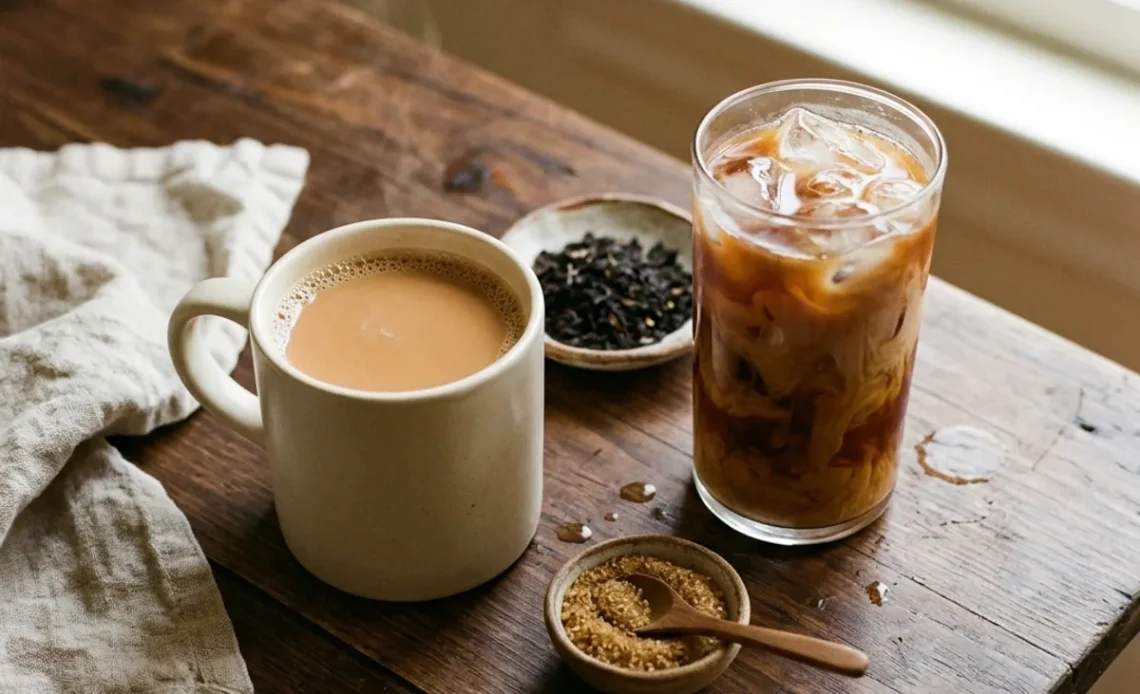
Start with strong black tea and the rest is easy.
Short answer: to make milk tea at home, steep 2 black tea bags per glass in a small amount of boiling water for 5 minutes, stir in 2 teaspoons of brown sugar, then add warm milk for a cozy mug or cold milk over ice. Each glass is about 96 calories.
The exact amounts for two glasses are in the recipe card.
I love how little this drink asks for: a kettle, a jug, a few tea bags and the milk you already have. It is gentle, creamy and just sweet enough to savor slowly, and the same base works in January in a warm mug or in July in a tall glass of ice.
For a spiced version over ice, try our iced chai tea recipe.
| Style | What goes in each glass | What the evidence shows | Main caution |
|---|---|---|---|
| Classic hot | 2 tea bags, 1/2 cup warm 2% milk, 2 tsp brown sugar: about 96 calories (USDA) | Tea studies only, see the research section | Caffeine: more than a regular cup of tea |
| Iced | The same base, cooled and poured over ice | Same as the hot version | Caffeine; brew strong so the ice does not water it down |
| Brown sugar | The same 2 tsp of sugar, melted into a syrup on the glass | No study on this drink | Added sugar adds up if you increase it |
| Hong Kong-style | Very strong Ceylon tea with evaporated milk | No study on this drink | Richer and higher in calories than 2% milk |
| Taro | The base blended with cooked taro root | No study on this drink | Cook the taro until completely soft |
| With boba | The base poured over tapioca pearls | No study on this drink | Pearls add starch and sugar; see boba tea drinks |
What milk tea is
Milk tea simply means tea with milk in it, and almost every tea-drinking culture has its own. A splash of milk in a British cuppa, Hong Kong’s silky evaporated-milk tea, the bubble tea of Taiwan with its chewy pearls: all of them count. The version here is the everyday one, black tea, milk and a little sugar, with no powder and no pearls. Once you have it, every other style is a small change away.
Choosing the black tea
Pick a robust, malty black tea. Assam is full and bold, Ceylon is brisk and bright, and English breakfast blends sit between the two. All three stand up to milk without disappearing. Bags are perfectly fine here; if you prefer loose tea, use 1 teaspoon per bag and strain it.
If you would rather skip black tea, our matcha latte is a green, creamy alternative made with the same milk.
Skip heavily perfumed teas: smoky or strongly scented blends can taste strange once the milk goes in. And if you love a more floral, toasty cup, oolong works beautifully with milk too, but it brews at a lower temperature. Our oolong milk tea recipe gives that method, including a cold brew version.
How to make milk tea: the strong-brew rule
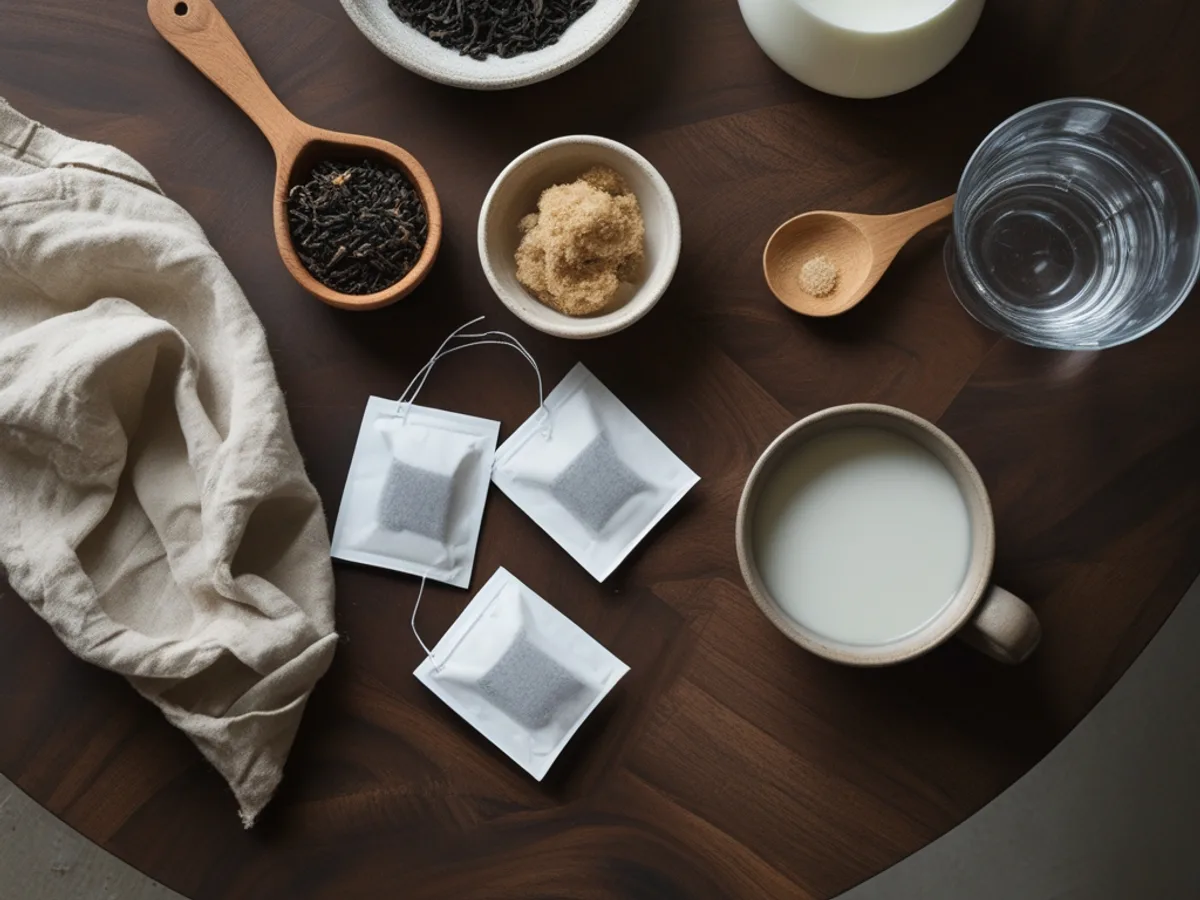
Milk softens everything it touches, so a tea brewed at normal strength ends up pale and milky, with almost no tea flavor. The technique that fixes it is simple: use twice the tea in less water. Here that means 4 bags in 1 1/2 cups of water for two glasses, which gives a dark, almost inky brew.
Then steep for 5 minutes and stop. Longer steeping does not make the tea much stronger, it makes it more bitter and drying. Lift the bags out and press them gently; squeezing them hard pushes out bitterness too.
Water matters a little as well. Use it freshly boiled, poured straight over the bags, because black tea needs that full heat to give its color and body.
Hot or iced, from one jug
This is the part I like best: the same jug of tea gives you both drinks.
Hot. Warm the milk in a small pan until it steams and small bubbles appear at the edge, then pour it into the tea. Warm milk keeps the mug hot and smells lovely; cold milk straight from the fridge cools the tea down fast.
Iced. Let the sweetened tea cool for about 10 minutes, or chill it in the fridge, before it meets the ice. Hot tea poured on ice melts half of it and leaves a watery glass.
Pour the tea over a full glass of ice, then add the cold milk last and watch it swirl down. Finish with a stir.
For an iced glass that stays strong to the last sip, freeze some of the brewed tea in an ice cube tray and use those cubes instead of plain ice.
Picking the milk
The recipe uses 2% milk, which gives a creamy drink without heaviness. A cup of 2% milk has about 122 calories and 8 g of protein, according to USDA, so each glass gets about 4 g of protein from the milk.
- Whole milk is richer and rounder, closest to a café drink.
- Soy milk is the dairy-free choice with the most body, and the one closest to cow’s milk in protein. Choose an unsweetened one.
- Oat milk is naturally sweet and smooth; barista versions froth well for the hot mug.
- Almond milk is lighter and thinner, so the tea flavor comes forward.
- Coconut milk has a strong taste of its own that tends to compete with the tea.
Heavy cream is optional, and I leave it out. It makes the drink feel more indulgent, but it adds a lot of fat and calories for a small change in texture. If dairy upsets your stomach because of lactose, lactose-free milk works exactly like regular milk here; the NIH’s digestive disease institute (NIDDK) notes that lactose-free and lactose-reduced milk may help lower the amount of lactose in your diet.
Sweetening it with less sugar
Two teaspoons of brown sugar per glass is enough to round off the tea’s edge without turning it into dessert. That is about 9 g of added sugar and 35 calories per glass, from USDA values. Brown sugar brings a soft caramel note that suits black tea; white sugar or a little honey work too.
Stir the sugar into the tea while it is hot, before the milk or ice, so it dissolves completely. Then taste a sip and decide: many people find one teaspoon per glass is plenty once they get used to it, and a good strong tea is lovely with no sugar at all. That small choice is what makes this homemade version such an easy lighter swap: you set the sweetness, not the shop.
Brown Sugar Milk Tea Recipe With a Caramel Swirl
The brown sugar milk tea recipe you see in tea shops, with its dark streaks down the glass, is the same drink assembled differently. Melt the 4 teaspoons of brown sugar with 1 tablespoon of hot water in a small pan, stirring for a minute until it turns into a thick syrup.
Tilt each glass and drizzle half the syrup around the inside, turning the glass so it coats the walls. Add ice, pour in the cold milk, then slowly pour the unsweetened, cooled tea on top.
The layers look beautiful; stir them together before you drink. The sugar stays at 2 teaspoons per glass, so the figures do not change.
Hong Kong-Style Milk Tea
Hong Kong milk tea is the boldest of the family: a very strong Ceylon tea, often simmered for a few minutes rather than just steeped, strained through a fine cloth, and finished with evaporated milk instead of fresh. Evaporated milk gives that silky, slightly cooked richness.
To try it at home, steep the 4 tea bags in 1 cup of water for the same 5 minutes, then stir in evaporated milk to taste and sweeten lightly. It is richer than the 2% version, so think of it as an occasional treat.
Taro Milk Bubble Tea Recipe With Real Taro
Taro is a starchy root with a gentle, nutty, almost vanilla flavor, and it turns the drink into something thick and comforting.
Peel a small taro root, cut it into cubes and boil or steam it until completely soft, about 15 to 20 minutes, since taro is always eaten cooked. Mash 1/2 cup of the cooked cubes with a little of the warm milk, then blend it with the sweetened tea and the rest of the milk until smooth. Real taro gives a pale lilac-grey drink, far softer than the vivid purple you may know from shops. Serve it hot in a mug, or cold over ice as a taro milk bubble tea.
Taro Boba Milk Tea Recipe: Adding the Pearls
For the chewy version, spoon cooked tapioca pearls into the bottom of each glass, add ice and pour the cold taro tea over them. The pearls themselves are covered in our boba tea drinks guide, which explains how to cook them and keep them chewy. They add starch and usually syrup, so this is the most filling glass on the page.
Milk tea vs boba
Milk tea is the drink: tea, milk, a touch of sugar. Boba, or bubble tea, is milk tea (or a fruit tea) with tapioca pearls at the bottom, drunk through a wide straw. The pearls are what change the numbers, since they bring starch and are usually soaked in syrup. If you love the chew, make it a weekend treat and keep the plain version for every day.
What the research says about tea with milk
There is no research on milk tea as a drink, but there is some on black tea, and one small trial looked at adding milk.
- Tea and blood pressure. A 2014 meta-analysis of 25 randomized trials with 1,476 participants found that drinking tea for weeks or months was linked to slightly lower blood pressure, about 1.8 mmHg systolic and 1.4 mmHg diastolic on average; drinking it once had no effect (PubMed 25137341, 2014). For black tea alone the drop was smaller, and the clearest results came from trials of 12 weeks or more.
- Adding milk. In a crossover trial, 17 healthy young adults drank hot water, black tea and black tea with milk for 4 weeks each. Black tea improved vascular function, measured as flow-mediated dilation of an arm artery, compared with hot water; with milk added to the black tea, that improvement was not seen, and blood pressure was slightly higher (PubMed 30411751, 2018). The authors say longer trials are needed, and 17 people is a very small group.
- Soy instead of cow’s milk. A 2024 meta-analysis of randomized trials found that replacing cow’s milk with soy milk did not harm established heart and metabolic risk markers, and may help blood lipids and blood pressure (PubMed 39169353, 2024).
So enjoy it for its comfort and flavor, not as a health drink. Plain black tea has the more interesting research; a lightly sweetened mug is simply a lighter choice than a sweet shop drink.
Caffeine, safety and who should cut back
Brewed black tea at regular strength has about 47 mg of caffeine per 8-ounce cup, according to USDA FoodData Central. Because this recipe uses two bags per glass, expect more than that in each glass. For most healthy adults, the FDA says up to 400 mg of caffeine a day is not generally associated with negative effects, though sensitivity varies from person to person.
- Pregnant, trying to become pregnant or breastfeeding, or living with a condition or taking medicine: the FDA advises asking your health care provider whether you should limit caffeine.
- Children: the FDA, citing the Dietary Guidelines for Americans, says caffeinated drinks are best avoided under age 2, and that drinks with no added sugars should come first for children and teens.
- Evening cups: use decaf black tea bags; the method is exactly the same. For a caffeine-free mug with milk, our golden milk recipe is a cozy alternative.
Make ahead and storing
Brew a double batch of the sweetened tea and keep it in a covered jar in the fridge, without the milk, for up to 3 days. Pour it over ice and add milk to order, or warm it gently for a hot mug. Once the milk is in, drink it the same day.
It separates as it sits, so give it a good stir or a shake in a closed jar before serving. Keep it cold, and do not leave the milk version out at room temperature.
Milk tea tips and common mistakes
- Pale, milky and bland: too little tea. Use 2 bags per glass.
- Bitter or dry: steeped too long or bags squeezed hard. Stop at 5 minutes.
- Watery iced glass: hot tea poured on ice. Cool it first, or use tea ice cubes.
- Grainy sweetness: sugar added to cold tea. Dissolve it while the tea is hot.
- Skin on the hot mug: the milk boiled. Warm it only until it steams.
Valérie C tried this milk tea today and says the texture was just what she hoped for, with a delicious flavor and very little effort.
For more hot and iced ideas, browse our tea drinks collection.
Sources
- Nutrition and caffeine: USDA FoodData Central, brewed black tea, 2% milk and brown sugar. Card values are estimates for one of 2 glasses.
- Caffeine guidance: FDA, Spilling the Beans: How Much Caffeine Is Too Much?
- Lactose: NIDDK (NIH), Eating, Diet, & Nutrition for Lactose Intolerance
- Studies: the PubMed records linked above.
Brew it strong, sweeten it lightly, and pour it the way the day calls for: warm in a mug or cold over ice, milk tea is a small moment worth slowing down for.

Milk Tea at Home, Hot or Iced, With Strong Black Tea and Less Sugar
Ingredients
- 4 black tea bags Assam, Ceylon or English breakfast; or 4 tsp loose black tea; decaf works too
- 1 1/2 cup boiling water 360 ml
- 4 tsp brown sugar 2 tsp per glass; use less or leave it out
- 1 cup milk 240 ml, 2% milk; or whole, soy or oat milk
- ice cubes for the iced version
Instructions
- Bring the water to a boil and pour it over the tea bags in a heatproof jug or teapot. Steep for 5 minutes, then lift the bags out, pressing them gently against the side with a spoon.
- Stir the brown sugar into the hot tea until it dissolves. For hot milk tea, warm the milk in a small pan until it steams, without letting it boil. For iced milk tea, let the tea cool for 10 minutes or chill it, and keep the milk cold.

- For hot, split the tea between 2 mugs and top each with half the warm milk. For iced, fill 2 tall glasses with ice, pour in the tea, then the cold milk, and stir before you drink. Taste and adjust with a splash more milk if you like it softer.
Notes
Nutrition
Frequently Asked Questions
What is the correct way to make tea with milk?
Brew the tea first in water that has just boiled, then add the milk: freshly boiled water draws the color and flavor out of black tea best. For this drink, use twice the usual amount of tea so the flavor survives the milk, and steep for 5 minutes.
How long steep Lipton black tea?
A regular black tea bag such as Lipton makes a good cup in 3 to 5 minutes; check the box for the brand’s own time. For this recipe, use two bags per glass and go the full 5 minutes so the tea stays strong under the milk.
What is the difference between boba and milk tea?
Milk tea is the drink itself: tea, milk and usually a little sweetener. Boba is milk tea, or another tea drink, served with chewy tapioca pearls at the bottom of the glass, which add starch and more sugar.
Can you give me a recipe for boba tea?
Yes. Cook dried tapioca pearls, soak them in a little brown sugar syrup and pour this tea over them with ice. Our boba tea drinks page walks through the pearls step by step, with seven drinks to choose from.
Does milk tea have caffeine?
Yes, unless you use decaf tea. Brewed black tea at regular strength has about 47 mg of caffeine per 8-ounce cup, according to USDA, and this recipe uses two bags per glass, so expect more than a regular cup.
Is milk tea healthy?
It depends on how it is made. This version has about 96 calories and 9 g of added sugar a glass, and the milk brings about 4 g of protein. Using less sugar, or none, is the simplest way to make it a lighter everyday drink.
What is the best tea for milk tea?
A strong, malty black tea such as Assam, Ceylon or an English breakfast blend. Heavily scented teas can taste odd with milk, and green tea gives a much lighter, grassier drink.