
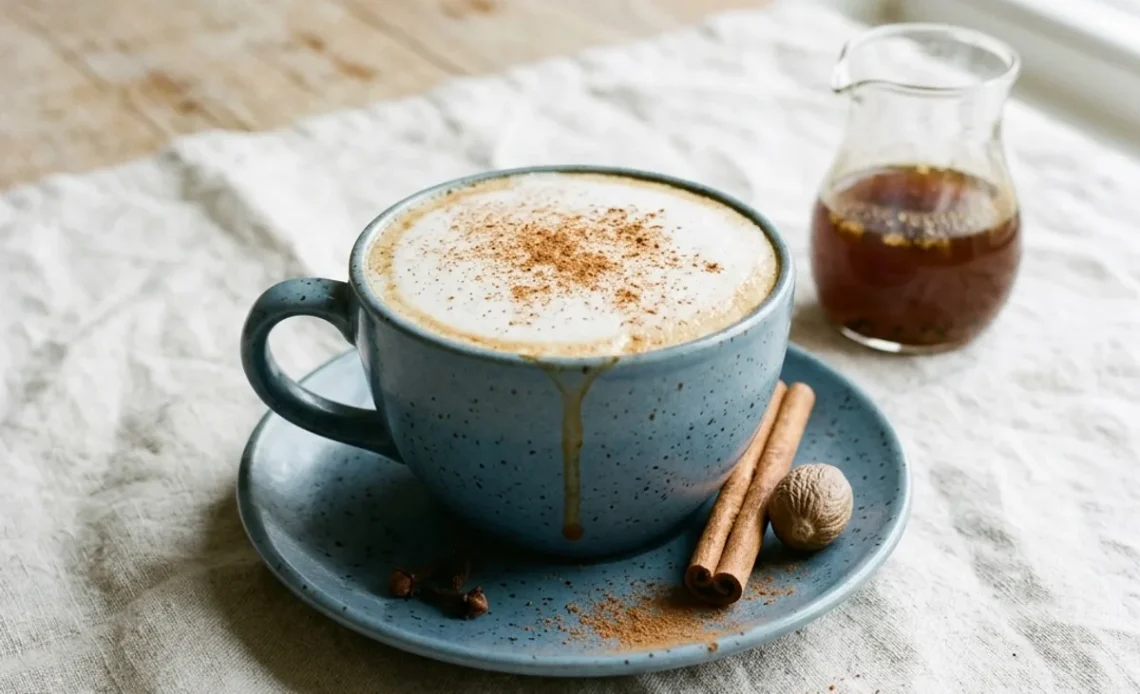
A good spice latte recipe is built on a syrup, not a shake of powder over the foam.
The short version: simmer 4 tablespoons of brown sugar with water, cinnamon sticks, cloves, fresh ginger and nutmeg for 8 minutes, then strain. Stir 2 tablespoons of this syrup into each double espresso and add 3/4 cup of frothed milk. That makes 4 lattes with about 1 tablespoon of sugar and 150 calories each.
The spices do the work that extra sugar usually does in a coffee-shop latte. A strong infusion tastes rich and sweet on its own, so the syrup can stay light. I make it from scratch with simple ingredients, and you can adjust the sweetness to your taste once it is in the mug. The recipe card has every quantity.
| Spice latte you might mean | What is in it | What the evidence shows | Main caution |
|---|---|---|---|
| This fall spice latte, hot | Espresso, 2% milk and a whole-spice brown sugar syrup: about 150 calories and 24 g carbohydrate a mug | No study on the drink itself; cinnamon and caffeine are covered below | Caffeine: about 126 mg from 2 fl oz of espresso (USDA) |
| Recipe pumpkin spice latte, homemade | The same mug with pumpkin puree whisked into the milk | No study on the drink itself | Same caffeine |
| Pumpkin spice latte coffee recipe with our syrup | Espresso and milk sweetened with our pumpkin spice syrup instead | No study on the drink itself | Sugar depends on how much syrup you pour |
| Pumpkin Spice Latte, Starbucks | Espresso, steamed milk, pumpkin flavor, cinnamon, nutmeg, clove, whipped cream and pumpkin-pie spices: 390 calories, 50 g sugars (Starbucks) | No study on the drink itself | About 150 mg caffeine, an approximate value (Starbucks) |
| Iced Pumpkin Spice Latte, Starbucks | The iced build: 370 calories, 45 g sugars (Starbucks) | No study on the drink itself | About 150 mg caffeine (Starbucks) |
| Pumpkin spice latte creamer | A sweetened creamer stirred into coffee instead of a syrup | No study on the drink itself | Sugar varies by brand: check the label |
Which spices go in a spice latte recipe
Four spices, each with a job. Cinnamon is the backbone: warm, sweet-smelling, and the flavor most people expect. Fresh ginger brings a little heat at the back of the throat, which keeps the milk from tasting flat.
Nutmeg adds the round, almost creamy note you know from eggnog and pumpkin pie. Cloves are the strongest of the four, so six are enough for a whole batch; more and the syrup tastes medicinal.
That same nutmeg warmth is the star of our eggnog latte.
Allspice, star anise or a few black peppercorns also work, one at a time. I prefer to keep the base to four spices and let cinnamon lead. Balance, not quantity, is what makes the syrup taste of fall.
Whole spices or ground spices?
Whole spices simmered and strained give a clear amber syrup with no grit at the bottom of the mug. Ground spices release their flavor faster, but they never fully dissolve: they cloud the syrup and settle as a muddy layer in the last sip. This recipe uses whole cinnamon, cloves and ginger, and only a quarter teaspoon of ground nutmeg, which is fine enough to stay suspended.
If ground spices are all you have, use 1 teaspoon of ground cinnamon, a quarter teaspoon each of ground ginger and nutmeg and a pinch of ground cloves, then strain the syrup through a paper coffee filter.
Cassia or Ceylon cinnamon?
According to NCCIH, cassia is the most common type of cinnamon sold in North America. Its sticks are darker, spicier, thick and hard.
Ceylon cinnamon is paler and milder, with thin, papery layers that crumble. Both work here. Cassia gives a bolder syrup; Ceylon a softer, more floral one.
There is a second difference. NCCIH notes that cassia contains coumarin, a compound with reported effects on the liver. Eating cassia usually does not bring enough coumarin to cause trouble, though some products contain high levels, and Ceylon has only a trace. Two sticks steeped for a batch of 4 lattes is a food amount.
How to make the spiced syrup
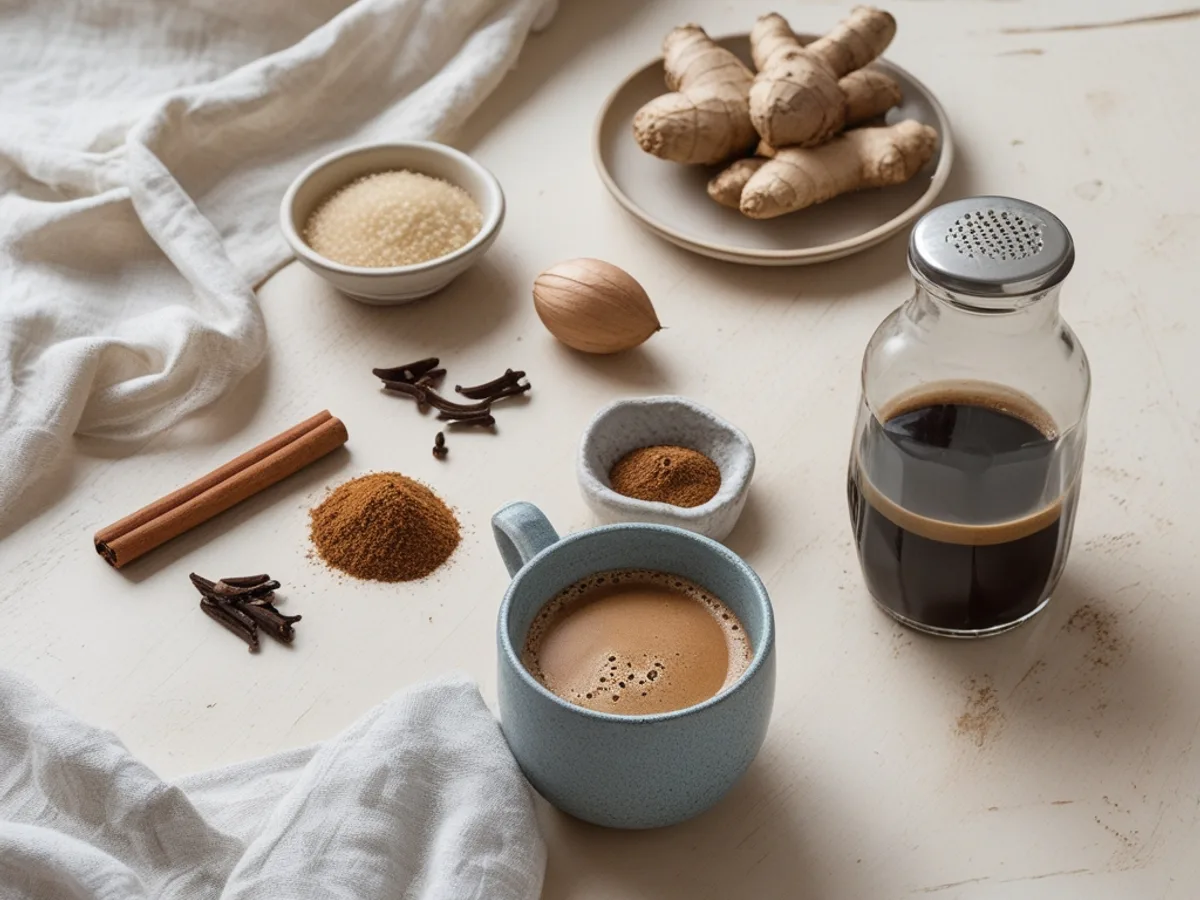
My mise en place: the saucepan with sugar, water and spices already in it, a fine sieve over a small jar, and the espresso ready to brew. The syrup itself needs 8 minutes and a few rules.
- Simmer, do not boil hard. A gentle simmer extracts the spices and slowly reduces the water. A rolling boil reduces it too fast, before the cinnamon has given its flavor.
- Reduce to half a cup. Two thirds of a cup of water should come down to about half a cup. That gives 2 tablespoons a mug, and a syrup concentrated enough to flavor 3/4 cup of milk.
- Leave the ginger unpeeled. Thin slices with the skin on are enough. They come out with the other spices in the sieve.
- Strain while warm. Warm syrup runs through the sieve easily. Cold, it is thicker and holds on to the spices.
- Vanilla at the end. Its aroma fades with heat, so it goes in once the pan is off the stove.
Brown sugar is my choice for this syrup. Its molasses note sits well with cinnamon and cloves, and it gives the amber color. White sugar works too, with a cleaner, lighter taste.
No espresso machine? Brewing the coffee
A spice latte needs a strong coffee base: 2 fl oz per mug, the volume of a double espresso. Without a machine:
- Moka pot. The closest to espresso at home. Fill it, brew it on medium heat and take it off as soon as it gurgles.
- AeroPress. Use a fine grind, a little water and press slowly for a short, concentrated coffee.
- French press or drip. Double your usual dose of ground coffee for the same water. Regular-strength drip coffee makes the latte taste like sweet milk.
Whatever the method, stir the syrup into the coffee while it is hot. That is the moment it dissolves completely.
Froth the milk at home
Milk for a latte should steam, not boil. Heat it in a saucepan or the microwave until small bubbles appear at the edge and it steams, then stop. Past that point it tastes flat and froths poorly.
To froth it, use a handheld frother, whisk it hard in the saucepan, or pour it into a jar no more than half full, close the lid tightly with a towel over it and shake for 30 seconds. Pour the hot milk into the mug while holding back the foam with a spoon, then spoon the foam on top. A pinch of ground cinnamon on the foam is the only topping this latte needs. Whipped cream is optional, and it adds sugar and fat the recipe card does not count.
Oat, almond or soy milk?
Any milk works with this syrup. A barista-style oat milk froths best and has a natural sweetness that suits the spices. Soy milk froths well too.
Almond milk is thinner and gives a lighter foam. Values change with the brand, so check the label; the nutrition on the recipe card is for 2% dairy milk.
Tips and mistakes: why a spice latte turns gritty or flat
- Powder in the milk. Stirring ground spices straight into the milk is the most common shortcut, and the reason many homemade lattes leave sludge in the cup. Infuse, then strain.
- Too many cloves. They dominate fast. Start with six; you can add a seventh next time.
- Syrup added to cold milk. It sinks and stays there. Stir it into the hot espresso first.
- Weak coffee. The spices need the bitterness of strong coffee to taste balanced.
- Boiled milk. Take it off the heat when it steams.
- Sweetened twice. Taste before adding more sugar. A spiced syrup tastes sweeter than its sugar content, and that is the point.
Iced spice latte
The iced version uses the same syrup and one change in order. Stir 2 tablespoons of syrup into the hot espresso, fill a tall glass with ice, pour the sweetened espresso over it, then add 3/4 cup of cold milk and stir. Cold milk does not dissolve syrup well, so it always goes in last. For an iced latte with more ice and the basic ratio, see our iced latte.
Pumpkin spice latte coffee recipe with real pumpkin
The spice latte and the pumpkin spice latte share the same spices. The difference is pumpkin.
The simplest way to add it to this spice latte recipe is puree: whisk 1 tablespoon of plain canned pumpkin puree per mug into the milk before heating it, then froth as usual. Use pure pumpkin, not pumpkin pie filling, which is already sweetened and spiced. The puree makes the latte thicker and gives it a light orange color.
Pumpkin spice latte recipe syrup: the faster route
Replace the spiced syrup with our pumpkin spice syrup, which already has real pumpkin and spices simmered in. It gives the closest taste to a coffee-shop pumpkin spice latte. Start with 2 tablespoons per mug and taste.
The puree route keeps this recipe’s light syrup and adds pumpkin flavor without more added sugar. The pumpkin syrup route is sweeter and faster if you already have a bottle in the fridge.
Pumpkin spice latte recipe Starbucks vs homemade
Starbucks describes its Pumpkin Spice Latte as its signature espresso and steamed milk with pumpkin, cinnamon, nutmeg and clove, topped with whipped cream and pumpkin-pie spices. For its standard recipe, it lists 390 calories, 50 grams of sugars, 52 grams of carbohydrate and 14 grams of fat, with about 150 mg of caffeine as an approximate value. The iced version comes to 370 calories and 45 grams of sugars. Starbucks notes that the figures change when a drink is customized.
This homemade latte is not a copy of that drink. There is no pumpkin flavoring or whipped cream, the spices are whole and strained, and one mug comes to about 150 calories and 24 grams of carbohydrate, according to USDA values.
How much sugar is in a spice latte?
Each mug gets a quarter of the syrup: about 1 tablespoon of brown sugar, or 52 calories and 14 grams of carbohydrate, according to USDA. The rest of the carbohydrate comes from the natural sugar of the milk. Measuring your own syrup helps with keeping added sugar in check, and the spices make a small amount taste like more.
To go lighter still:
- Use half the syrup. One tablespoon per mug still tastes spiced, because cinnamon and nutmeg read as sweet.
- Spice the milk too. Add a cinnamon stick to the milk while it heats, then remove it before frothing.
- Make a smaller mug. One shot of espresso and 1/2 cup of milk with 1 tablespoon of syrup.
Spice latte vs chai latte
Both are spiced and milky, but the base differs. A chai latte is black tea simmered with spices such as cardamom, cinnamon, ginger and cloves; our chai latte recipe makes it from whole spices. A spice latte uses espresso, so it tastes more of coffee and roasted notes, and it usually skips cardamom. If you want both, add a shot of espresso to a chai for a dirty chai.
If you want a cold, tea-based spiced drink instead, our iced chai tea recipe is made with chai tea bags.
Variations on this spice latte recipe
- Decaf. Decaf espresso keeps the flavor with much less caffeine: a fall spice latte for the afternoon or evening.
- Maple. Replace the brown sugar with the same amount of maple syrup and simmer only 5 minutes, since it is already liquid.
- Vanilla-forward. Double the vanilla, or use the syrup on top of our vanilla latte for a spiced vanilla version.
- Orange. Add a strip of orange zest to the simmering syrup and strain it out with the spices.
For more warm and cold drinks built on tea, coffee and homemade syrups, browse our tea drinks collection.
Storing the syrup
The strained syrup keeps in a closed jar in the fridge. It thickens slightly as it cools; warm the jar a few seconds in hot water, or stir it straight into hot espresso, where it loosens at once. Make the lattes themselves just before serving: frothed milk loses its foam within minutes.
Mathieu M stirred the syrup into the espresso with nothing changed, and it came together fast: the spiced latte was delicious, the milk had the texture hoped for, and Mathieu would make it again.
What the evidence says about cinnamon and caffeine
No trial has studied a spice latte. The evidence that exists concerns its two most discussed parts, cinnamon and caffeine, at doses that are not always those of a mug.
- Cinnamon and blood sugar. A 2024 meta-analysis of 24 randomized trials in people with type 2 diabetes found that cinnamon supplements lowered fasting blood sugar and HbA1c compared with control groups, and the authors see a possible role as an adjunct therapy (PubMed 37818728). Those trials used supplements, not the cinnamon of one latte. NCCIH, for its part, considers it unclear whether cinnamon supplementation helps with diabetes or weight loss and calls for higher quality research.
- Caffeine and sleep. A meta-analysis of 24 studies found that caffeine reduced total sleep time by 45 minutes on average; to avoid that, the authors suggest having coffee (107 mg per 250 ml) at least 8.8 hours before bedtime (PubMed 36870101, 2023).
- Dose and timing. In a crossover trial in 23 young men, 100 mg of caffeine had no significant effect on sleep even 4 hours before bed, while 400 mg disturbed it when taken within 12 hours of bedtime (PubMed 39377163, 2025). The sample was small and male only.
In practice: the spices are flavor, not treatment, and a mug of about 126 mg of caffeine fits best earlier in the day, or in decaf after lunch.
Safety: caffeine and cinnamon limits
One mug has about 126 mg of caffeine, from 2 fl oz of espresso according to USDA. The FDA cites 400 milligrams a day for most adults as an amount not generally associated with negative effects, while sensitivity varies from person to person.
If you are pregnant, trying to become pregnant or breastfeeding, or you have a condition or take a medication caffeine may affect, the FDA recommends asking your health care provider whether to limit it. MedlinePlus notes that caffeine can increase stomach acid and sometimes cause heartburn. For children, the Dietary Guidelines cited by the FDA say caffeinated drinks should be avoided under age 2 and that drinks with no added sugars come first for children and teens.
For the cinnamon, NCCIH considers it likely safe in the amounts used in foods; larger amounts or long use are sometimes linked to gastrointestinal problems or allergic reactions. Prolonged use of cassia could be an issue for sensitive people, such as those with liver disease, and anyone taking medicine should talk with a health care provider before using cinnamon as an herbal product. This recipe uses it as a spice.
Where the numbers come from
- Nutrition and caffeine: USDA FoodData Central, 2% milk, espresso, brown sugar, ground nutmeg and ground cinnamon. The recipe card values are estimates for one of 4 mugs.
- Caffeine guidance: FDA, Spilling the Beans: How Much Caffeine Is Too Much?, and MedlinePlus, Caffeine.
- Cinnamon: NCCIH, Cinnamon.
- Starbucks drinks: nutrition pages for the Pumpkin Spice Latte and the Iced Pumpkin Spice Latte, and the product description.
- Studies: PubMed records linked above.
Simmer the spices, strain, and keep the jar in the fridge: with the syrup ready, this spice latte recipe takes five minutes on a cold morning, hot or over ice.
A Spice Latte Recipe With Whole Spices and One Tablespoon of Sugar
Ingredients
Spiced syrup
- 4 tbsp brown sugar 1/4 cup packed, about 55 g
- 2/3 cup water 160 ml
- 2 cinnamon sticks about 3 inches each
- 6 whole cloves
- 4 fresh ginger slices thin, unpeeled
- 1/4 tsp ground nutmeg or freshly grated
- 1/2 tsp vanilla extract
Lattes
- 8 fl oz espresso 240 ml, 2 shots per mug, or very strong coffee
- 3 cup milk 2% milk, 720 ml
- 1/4 tsp ground cinnamon for dusting
Instructions
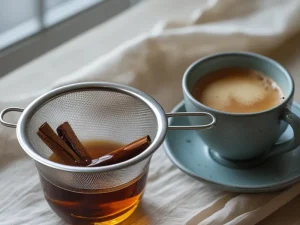
- Put the brown sugar, water, cinnamon sticks, cloves, ginger slices and nutmeg in a small saucepan. Bring to a gentle simmer over medium heat, stirring until the sugar dissolves, then simmer for 8 minutes, until it has reduced to about 1/2 cup and smells strongly of cinnamon. Take it off the heat and stir in the vanilla.
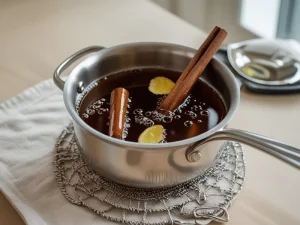
- Pour the syrup through a fine sieve into a small jar and discard the spices. Brew the espresso. Put 2 tablespoons of warm syrup in each of 4 mugs, add 2 fl oz of espresso to each and stir.
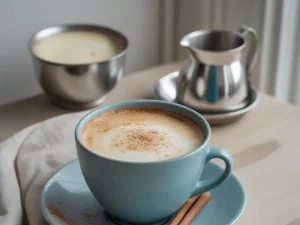
- Heat the milk until it steams and small bubbles form at the edge, without letting it boil, then froth it with a frother, a whisk or a sealed jar. Pour 3/4 cup into each mug, spoon the foam on top and dust each latte with a pinch of ground cinnamon.
Notes
Nutrition
Frequently Asked Questions
How to make a hot flavored latte?
Dissolve a flavored syrup in hot espresso first, then add steamed, frothed milk. For this spice latte, 2 tablespoons of spiced syrup go into 2 fl oz of espresso, followed by 3/4 cup of milk heated until it steams.
Is there caffeine in pumpkin spice lattes at Starbucks?
Yes. Starbucks lists about 150 mg of caffeine for its standard Pumpkin Spice Latte, hot or iced, and calls it an approximate value. This homemade spice latte has about 126 mg per mug, from 2 fl oz of espresso according to USDA.
What spices are in chai latte?
Chai usually combines cinnamon, cardamom, cloves, ginger and often black pepper, steeped with black tea. A spice latte keeps the cinnamon, cloves and ginger, adds nutmeg, and uses espresso instead of tea.
How to make a sweet latte?
Sweeten the espresso, not the milk: a syrup mixes evenly into hot coffee. Start with 2 tablespoons of this spiced syrup per mug, taste, and add more if you want it sweeter.
Can I make a spice latte with ground spices only?
Yes, but whisk them into the hot syrup and strain it through a paper coffee filter, or the last sips turn gritty. Whole spices give a clearer syrup with a cleaner flavor.